Why the Shelf Price Rarely Moves: Inside the Rules That Keep Canadian Drug Costs Predictable
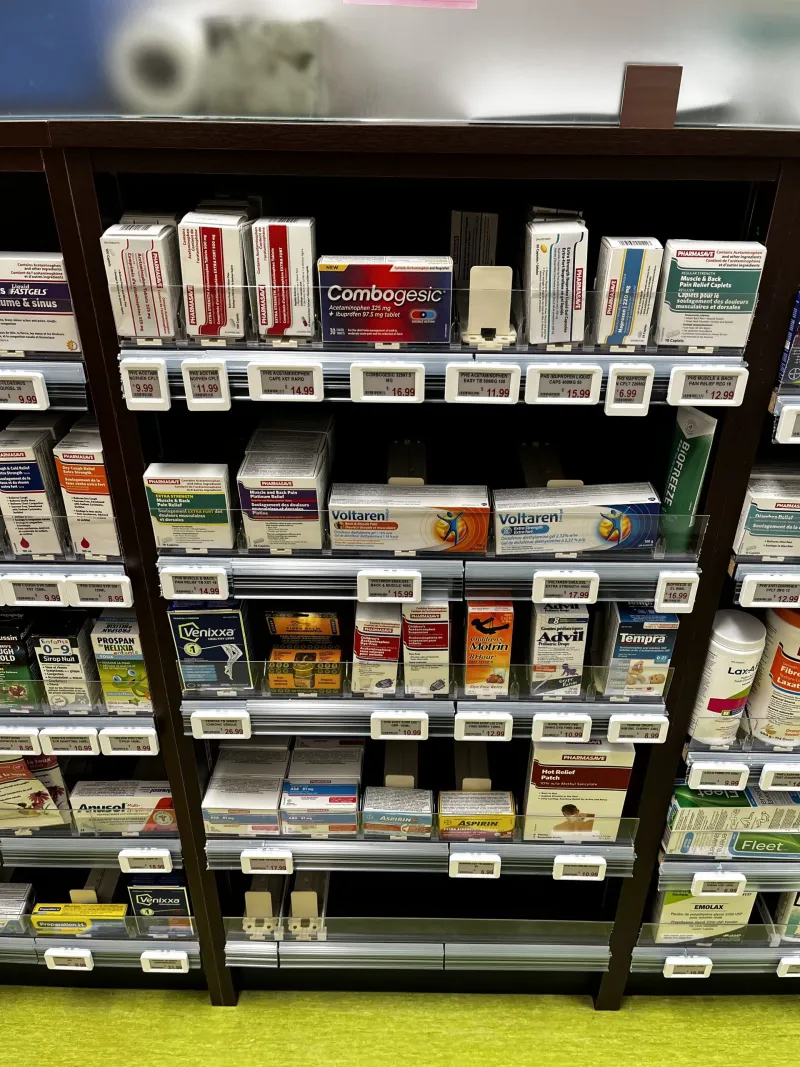
Photo: pharmacy shelf prescription medication price tags Canada, via www.electronicshelftags.com
For many Americans, the first encounter with Canadian prescription pricing feels almost suspicious. A medication that crept upward by double digits year after year at a local pharmacy appears on a Canadian price list — and then stays there. Not for a week. For years.
That consistency isn't a marketing gimmick. It's the result of a regulatory architecture that has been built, layer by layer, over decades. Understanding how it works helps explain not only why Canadian prices are lower, but why they behave so differently from the prices Americans are used to.
Two Layers of Oversight
Canadian drug pricing sits under two distinct systems, and each plays a different role.
At the federal level, the Patented Medicine Prices Review Board, or PMPRB, acts as a watchdog over the manufacturers of patented medications. It doesn't set shelf prices, but it enforces price ceilings: companies introducing a new patented drug in Canada cannot charge more than what the board deems excessive relative to prices in comparable countries. When a manufacturer crosses that line, the board can order the price reduced and the excess repaid.
Below that sits the provincial layer. Each province — Ontario, British Columbia, Alberta, Quebec, and the rest — maintains its own formulary, the list of medications covered by its public drug plan. Provinces negotiate directly with manufacturers and typically pay prices benchmarked against what other provinces pay. Because provinces collectively represent enormous purchasing power, those negotiated rates ripple outward and effectively anchor what private pharmacies pay for generic and brand-name drugs alike.
The result is a system where prices are negotiated, benchmarked, and capped — rather than left to whatever the market will bear.
What the Sticker Price Actually Contains
When an American customer sees a Canadian price for a 90-day supply, that figure bundles several components. There is the drug's acquisition cost, set by the supply chains described above. There is the pharmacist's professional dispensing fee, which compensates the pharmacy for the work of verifying, filling, and counselling on the prescription. And there may be a modest markup permitted under provincial pharmacy regulations, which in most provinces are themselves capped by rule.
This transparency matters for consumers. A dispensing fee is not a hidden charge; it is a regulated, disclosed line item. In several provinces, the maximum a pharmacist may charge to fill a prescription is published openly, which means the arithmetic behind a Canadian price quote can be traced and verified rather than guessed at.
Compare that with the opaque world of American pharmacy pricing, where a single medication may carry three or four different prices depending on insurance intermediaries, rebate arrangements, and pharmacy benefit managers — none of which are visible to the person paying at the counter.
Why Prices Stay Put
The second half of the pricing puzzle is stability, and it flows from two sources.
First, generic drugs in Canada are sold under fiercely competitive, benchmark-driven conditions. Provinces and private plans routinely pay a capped price per generic prescription, and those caps are revisited on a predictable schedule, not subject to sudden supplier-driven increases.
Second, patented drug prices cannot be raised arbitrarily. The PMPRB reviews price increases against a consumer price index, and manufacturers that raise prices beyond permitted thresholds face enforcement. In practice, this means the price of a Canadian maintenance medication — a statin, a blood pressure drug, a thyroid medication — is far more likely to be identical in January and December than its American counterpart.
For American patients budgeting a fixed income around monthly prescriptions, that predictability carries real weight. A price that holds still is easier to plan around than one that surprises.
What This Means for Cross-Border Shoppers
None of this turns Canada into a discount warehouse — Canadian regulators set prices with Canadian patients in mind, and the system exists primarily to serve them. But because those regulated prices are so much lower than prevailing American prices, Americans ordering through legitimate Canadian pharmacies benefit from the same stability Canadian patients enjoy.
The practical takeaway for consumers is straightforward. When comparing prices from a Canadian source, expect the quote to reflect a regulated acquisition cost plus a disclosed dispensing fee. Expect that the price next quarter will look like the price today. And expect that any dramatic, unexplained fluctuation — up or down — is a reason to ask questions rather than a feature of the market.
Predictability is easy to overlook until you've lived without it. For millions of Americans managing chronic conditions on fixed budgets, the quiet, rule-bound nature of Canadian drug pricing is not a technicality. It is the reason the math keeps working, month after month and refill after refill.