Before the Suitcase Opens: Timing Your Canadian Refills Around the Trip You've Already Booked
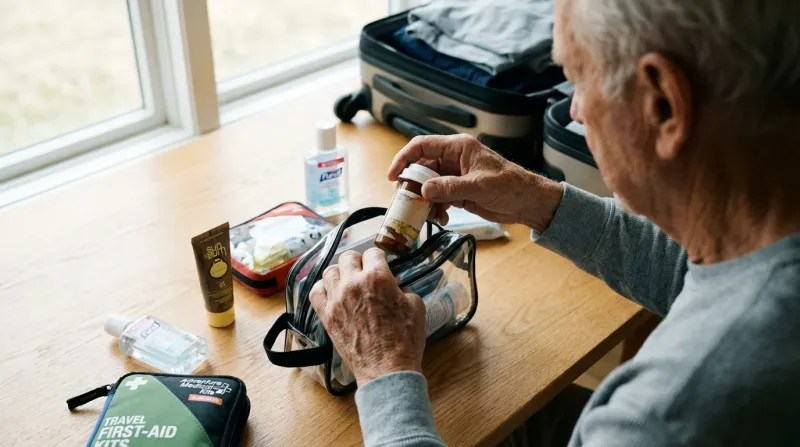
Photo: senior traveler packing prescription medication bottles suitcase planning trip, via seniorlifeadventures.com
The plane ticket is booked, the cabin is reserved, and the calendar is circled. Then you glance at the pill organizer and realize the math doesn't work: your supply runs out four days into a two-week trip. For Americans who rely on Canadian pharmacies for affordable maintenance medications, travel planning is really refill planning — and the two can be reconciled with a little foresight.
Why Travel Exposes the Refill Gap
Maintenance prescriptions are usually dispensed in 30- or 90-day cycles, and insurers and pharmacies alike build rules around those cycles. A trip that straddles a refill date creates a hard stop: no shipment arriving at an empty house, no local pharmacy willing to fill early without coordination, and no convenient way to redirect an order already in transit.
The problem compounds for cross-border orders. A licensed Canadian pharmacy needs your valid prescription on file, a pharmacist must review it, and the package needs mailing time — typically seven to fourteen business days to most American addresses. Planning backwards from your departure date is therefore not optional; it is the entire exercise.
The Working-Backwards Timeline
Every trip is different, but the sequence below adapts to nearly any of them. Fill in the blanks with your own dates.
Day 0 — Departure date. Write it down. Everything counts backwards from here.
Departure minus 21 days — Place the order. This is the latest comfortable point for a standard cross-border shipment. Ordering earlier is fine; ordering later leaves you depending on the mail.
Departure minus 28 to 35 days — Confirm the prescription. If your prescription is new, or your refills are exhausted, this is when you contact your American prescriber. Canadian pharmacists cannot dispense without a valid prescription, and a last-minute fax from a busy doctor's office is a gamble you don't need.
Departure minus 14 days — Verify shipment and track. Confirm the order has shipped, note the tracking number, and check the declared quantity. If anything looks wrong, there is still time to resolve it.
Departure minus 7 days — Medication in hand. Aim to have your supply a full week before leaving. This buffer absorbs a delayed package and gives you time to pack properly.
Departure minus 3 days — Pack and document. Keep medications in original labelled containers, carry copies of your prescriptions, and pack everything in your carry-on, never checked luggage.
Carrying Medication Across Borders
Travelers often worry more about the border than the mailbox, and reasonably so — but the rules for personal use are straightforward when followed honestly.
- Keep original packaging. Pharmacist-labelled bottles with your name, drug, and directions are your best documentation.
- Carry a prescription copy or doctor's letter, particularly for controlled substances, injectables, or medications exceeding 90 days.
- Declare what you're carrying. Both U.S. and Canadian customs generally permit personal-use quantities of prescription medication when declared and documented. Undeclared medication is where travelers get into trouble.
- Know quantity limits. A 90-day personal supply is the widely accepted standard for crossing into the United States; anything beyond that invites questions.
Special Cases Worth Planning For
Snowbird season. Extended stays in Arizona or Florida stretch beyond a single 90-day fill. Some travelers coordinate two shipments — one before departure, one to the winter address — but Canadian pharmacies ship only within Canada and to the U.S., so confirm your winter address is serviceable before ordering.
Cruises. Port days and shipboard pharmacies make poor fallbacks. Build your buffer generously and carry a printed medication list including generic names, since brand names differ between countries.
Time-zone changes. Dosing schedules anchored to clock times can drift on long trips. Ask your pharmacist or physician whether to shift gradually or hold to your home time zone — a five-minute conversation that prevents a week of confusion.
Temperature-sensitive medications. Insulin and certain biologics require cold storage. A car glovebox in Phoenix is not a plan; insulated pouches and refrigeration at your destination are.
The Fill-in-the-Blank Card
Copy this onto the fridge or into your phone:
- Departure date: ______
- Order placed by: ______ (departure minus 21 days)
- Prescription confirmed by: ______ (departure minus 28 days)
- Package received by: ______ (departure minus 7 days)
- Prescription copies packed: yes / no
- Medications in carry-on: yes / no
- Destination pharmacy located (if applicable): ______
A Closing Thought
The travelers who never break their refill chain are not lucky — they are early. Ordering from Canada rewards the same habit that makes it affordable in the first place: patience, documentation, and a calendar you actually consult. Book the trip, then work backwards, and the medication will be waiting in your carry-on rather than missing you at home.