A Logo Is Not a License: How to Verify a Canadian Pharmacy's Credentials in Five Minutes
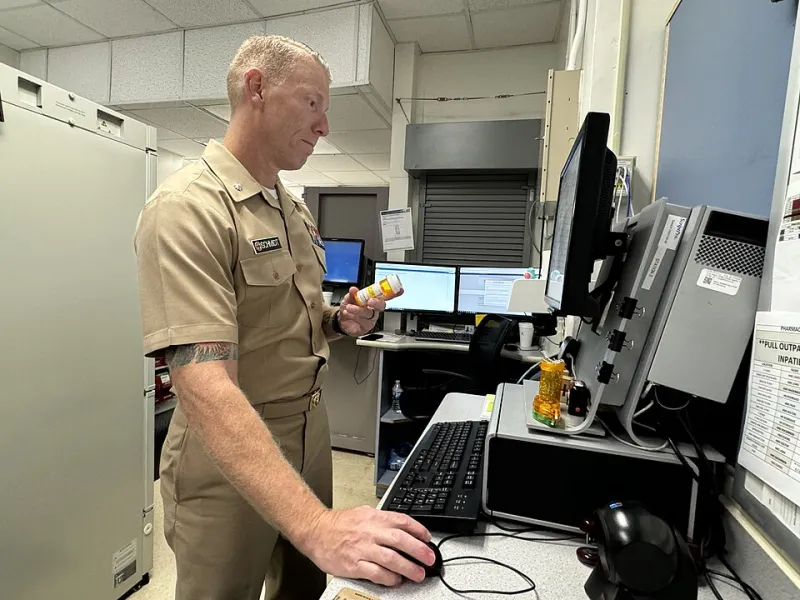
Photo: U.S. Navy NMRTC by Emily McCamy, Public domain, via Wikimedia Commons
The internet has made it remarkably easy to look Canadian. A red maple leaf, a reference to Vancouver or Toronto, a promise of "licensed pharmacists" — these cost a counterfeit operator nothing. What they cannot easily fake is a number: the license issued by a Canadian provincial pharmacy regulator.
For American consumers comparing prices across the border, understanding that distinction is the single most important safety step you can take. Here is what a provincial license actually means, and how to confirm one exists before you place an order.
What a Provincial License Actually Guarantees
In Canada, pharmacy regulation happens at the provincial level, not federally. Each province has its own regulatory college — for example, the College of Pharmacists of Manitoba, the Ontario College of Pharmacists, or the College of Pharmacists of British Columbia. These bodies are not trade associations or marketing groups. They are arms-length regulators with legal authority over every pharmacy and pharmacist practicing in their jurisdiction.
A valid provincial license means several concrete things:
Regulatory oversight. The pharmacy operates under a physical, inspectable premises. Regulators conduct inspections and can impose conditions, fines, or closure.
Pharmacist accountability. Every prescription is reviewed by a pharmacist who holds an individual license in good standing. That pharmacist can be disciplined — and even lose their livelihood — for dispensing errors or unsafe practices. That personal stake changes behavior in ways no corporate policy can.
Recourse. If something goes wrong, you have somewhere to complain that has real power. A regulator can investigate, discipline a licensee, and coordinate with authorities. A website with no verifiable license leaves you with, essentially, a contact form.
The Maple Leaf Test: Why Branding Proves Nothing
Consider the asymmetry. A legitimate pharmacy spends money on licenses, inspections, licensed staff, and secure supply chains. An illegitimate one spends money on a logo. Both can display the same flag, quote the same reassurances, and use similar language about "trusted Canadian standards."
This is why the visual signals American shoppers often rely on — the flag, the .ca domain, even a Canadian mailing address — are unreliable on their own. What cannot be borrowed is a listing in a provincial regulator's public register.
Verify in Five Minutes: A Step-by-Step Guide
You do not need any special knowledge to check a pharmacy's credentials. Here is the process:
Step 1: Identify the province. A legitimate Canadian online pharmacy will state where it is licensed and physically located. If this information is missing or vague, stop there.
Step 2: Find the provincial regulator's public register. Every provincial college maintains a searchable, free public register of licensed pharmacies and pharmacists. Examples include the College of Pharmacists of Manitoba's registrant search, Ontario's public register, and British Columbia's licensee lookup. A web search for the province name plus "college of pharmacists public register" will surface the official site.
Step 3: Search for the pharmacy by name. Enter the exact business name. Confirm the listing is active, note the licensed address, and check for any conditions or disciplinary history attached to the license.
Step 4: Search for the pharmacist in charge. Reputable pharmacies identify their supervising pharmacist. Verify that individual's license is active and in good standing.
Step 5: Cross-check the details. The address and pharmacy name on the regulator's register should match what appears on the pharmacy's website. Mismatches are a red flag worth investigating before you order.
Additional Signals Worth Checking
Beyond the license itself, a few practices distinguish legitimate cross-border pharmacies:
- A real prescription requirement. Any operation offering to sell prescription drugs without a valid prescription from your physician is operating outside both Canadian and American law.
- A licensed pharmacist available for questions. You should be able to speak with a pharmacist, not only a customer service agent.
- Transparent shipping and cold-chain practices. Medications like insulin require temperature control; a trustworthy pharmacy will explain how it protects them.
- Clear pricing. Prices in Canada are regulated and comparatively stable, so suspiciously low offers — far below typical Canadian rates — often signal counterfeit product rather than a bargain.
A Final Word on Due Diligence
Price is the reason Americans look north, and that price advantage is real. But the savings only matter if the medication arriving at your door is genuine, properly stored, and dispensed by a licensed professional. Five minutes with a provincial regulator's public register is the most cost-effective insurance in healthcare: it costs nothing and protects everything.
Before your next order, skip the logo and check the license. The difference between the two is the difference between a pharmacy and a picture of one.